Wild Cat Species
Pallas’s Cat
Some researchers believe Manul, or Pallas's cat, to be the oldest living cat species. Its evolution dates back as far as ten million years.
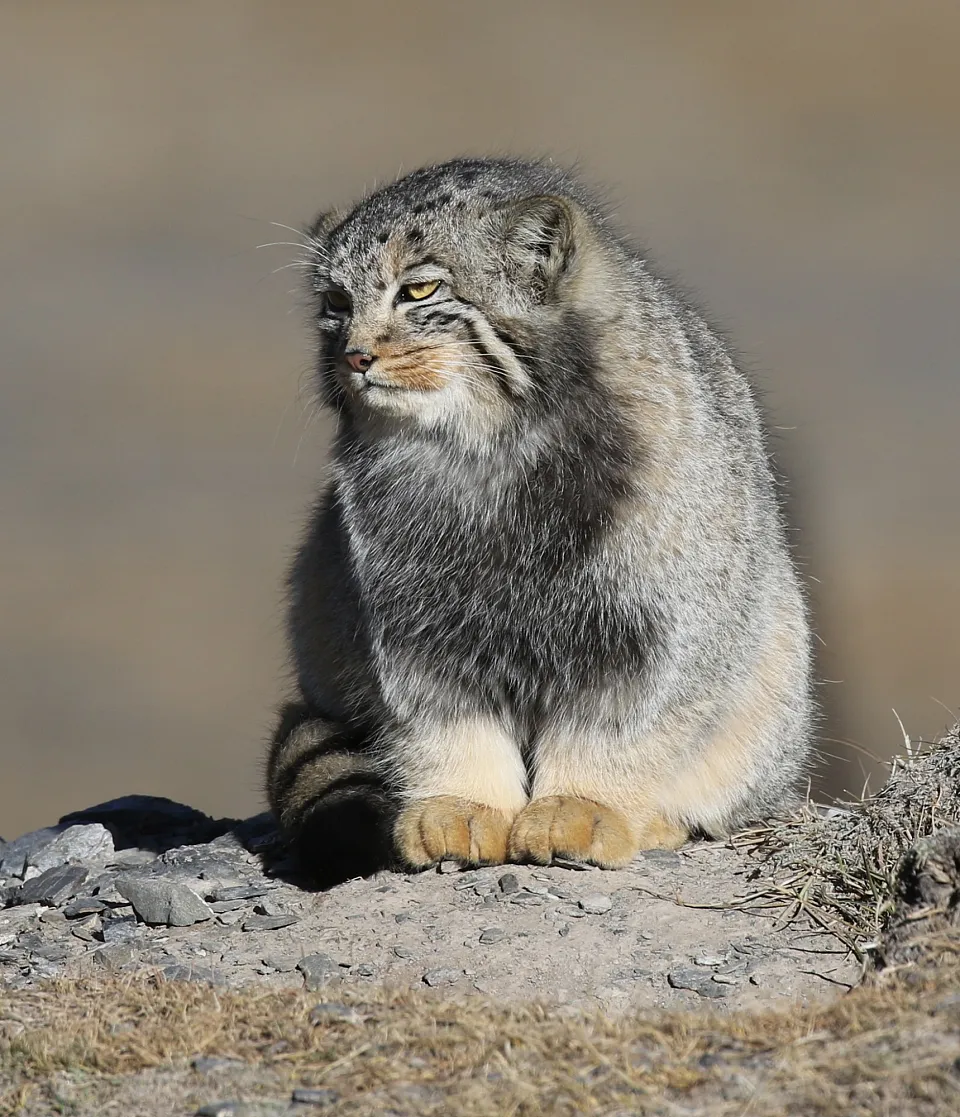
Species Facts
- Publication Date: August 20, 2021
- Scientific Designation: Otocolobus manul
- Endangered Status: Least Concern (LC)
- Lifespan: Up to 11.5 years
- Weight: 2-5 kg
- Body Length: 50-65 cm
- Tail Length: 21-31 cm
Appearance
The Pallas's cat is a squat, short-legged felid with a thick, bushy tail that is about half the length of its head and body combined. Although its long coat and thick fur make it appear quite large, this cat is actually about the size of a domestic house cat. Characterized by a broad head and low forehead, the manul’s face is flattened and its ears are short and set very wide apart. The tail is marked with four to seven narrow black rings, with a black tip. The coat is a grizzled or silvery buff color. The chin and the upper parts of the throat are white.
Behavior
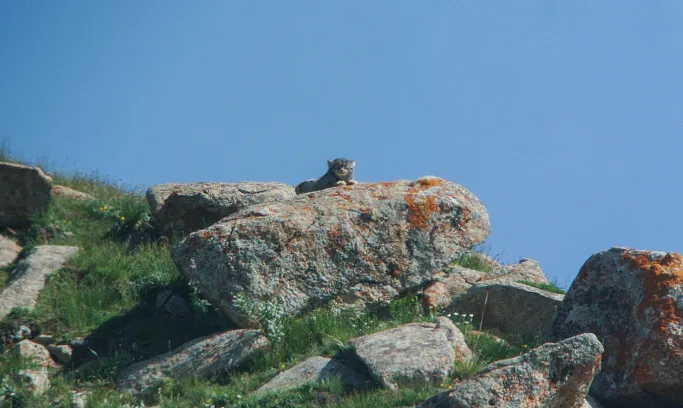
Nocturnal by nature, the manul spends the day in caves, rock crevices, or marmot burrows, emerging in the late afternoon to begin a night of hunting. However, this cat is likely diurnal because its prey is active during the daytime. These cats hunt by stalking or creeping up on prey, as their short legs do not allow them run well. Hunting mostly by sight, these cats use sparse vegetation as stalking cover and their low-set ears and flat forehead are adaptations for hunting in open terrain. The manul feeds on pikas, gerbils, voles, mouse-like rodents, and chukar partridge.
Species Distribution
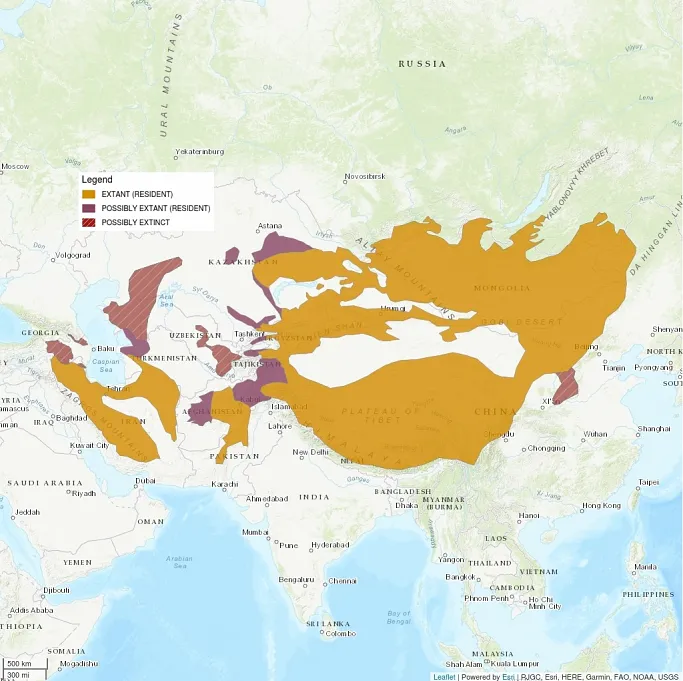
The manul’s distribution ranges throughout Asia and the Middle East. Within its distribution in central Asia, this cat inhabits uplands, hilly areas, and steppes with rocky outcrops, as well as semidesert areas. It is especially abundant on the cold grasslands of Mongolia and Inner Mongolia. It lives from lower elevations to 3,000 to 4,000 meters. Its typical habitat has an extreme continental climate, characterized by little rainfall, low humidity, and a wide range of temperatures.
Distribution map courtesy of IUCN (International Union for Conservation of Nature), compiled in 2020.
Threats to the Pallas's Cat
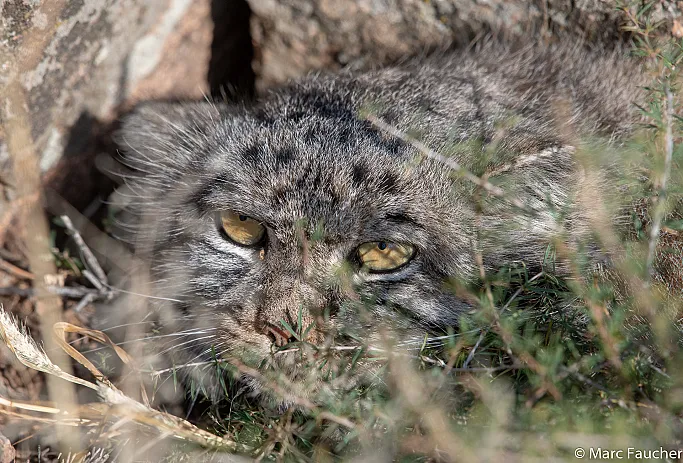
The manul is primarily threatened with hunting for its fur.
This species is classified as Least Concern (LC) by the International Union for Conservation of Nature (IUCN) and protected under appendix II of the Convention on International Trade in Endangered Species (CITES).
Want to help us research and conserve this species?
Felidae Conservation Fund helps researchers around the world study and protect felids of all sizes.
Make sure you write a comment with "Pallas’s Cat" so we can designate 100% of your donation to go to protecting this species.
Support the work behind this page
Felidae is a 501(c)(3) nonprofit. Gifts fund field research, community science and habitat protection.