Wild Cat Species
Andean Mountain Cat
The Andean mountain cat is one of the least known felids in South America. It is extremely rare, with a very small distribution.
Species Facts
- Publication Date: August 20, 2021
- Scientific Designation: Leopardus jacobita
- Endangered Status: Endangered (EN)
- Lifespan: Unknown
- Length: 95-130 cm
Profile
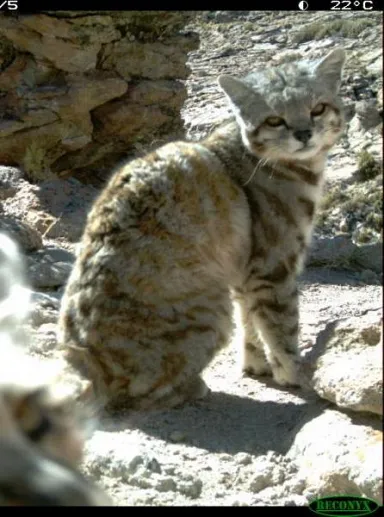
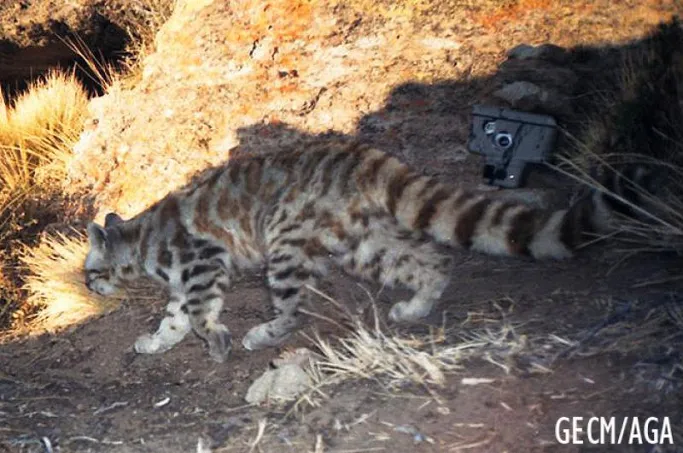
The species has long, thick fur and a coat of a pale, silvery gray. The coat is spotted and striped with blackish or brownish markings. White underparts are marked with dark spots. The tail is long and bushy, banded with about seven dark rings.
Distribution
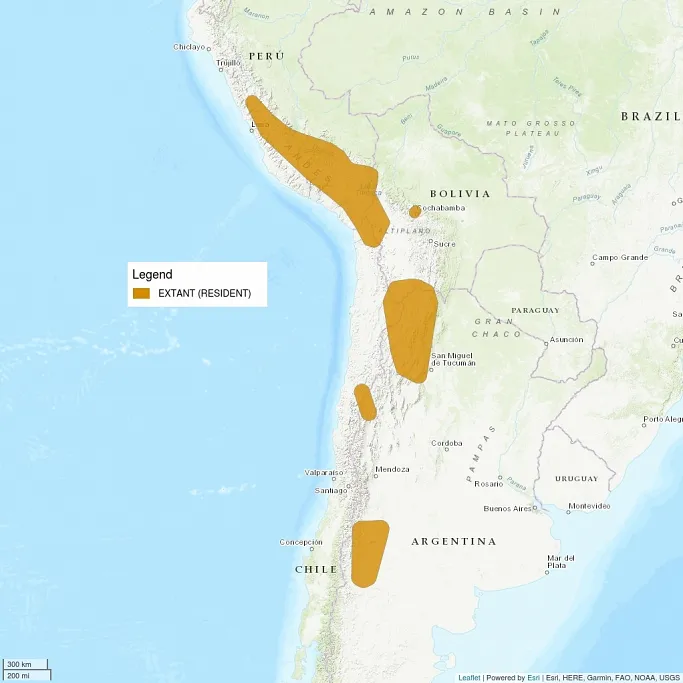
The mountain cat lives high in the Andes of southern Peru, southwestern Bolivia, northeastern Chile, and northern Argentina. Within this limited range, the elusive mountain cat is usually found at elevations above 3,000 meters in the high, rocky, and generally treeless zone of the mountains. A mountain cat probably eats any small mammal, bird, or lizard it can catch.
Little is known about this cat. However, in the few cases when it has been observed, it seems to be active in periods both in the day and the night.
Distribution map courtesy of IUCN (International Union for Conservation of Nature), compiled in 2016 by Villalba, M.L., Lucherini, M., Walker, S., Lagos, N., Cossios, D., and Bennett, M.
Threats to the Andean Mountain Cat
Threats to this rare species include illegal hunting for its fur and habitat fragmentation. The loss of even a few individuals from the mountain cat’s small population could be disastrous. The Andean Mountain Cat is classified as Endangered (EN) by the International Union for Conservation of Nature (IUCN).
Want to help us research and conserve this species?
Felidae Conservation Fund helps researchers around the world study and protect felids of all sizes.
Make sure you write a comment with "Andean Mountain Cat" so we can designate 100% of your donation to go to protecting this species.
Support the work behind this page
Felidae is a 501(c)(3) nonprofit. Gifts fund field research, community science and habitat protection.