Field research
Bay Area Bobcat Project
Fragmentation of habitat is a major threat to wildlife populations throughout the San Francisco Bay Area. With this project we will learn more about species movement in several locations in the Santa Cruz and Diablo Mountain ranges. This will enable us to make informed recommendations to land managers and roadway engineers concerning location of wildlife corridors to help protect local ecosystems.
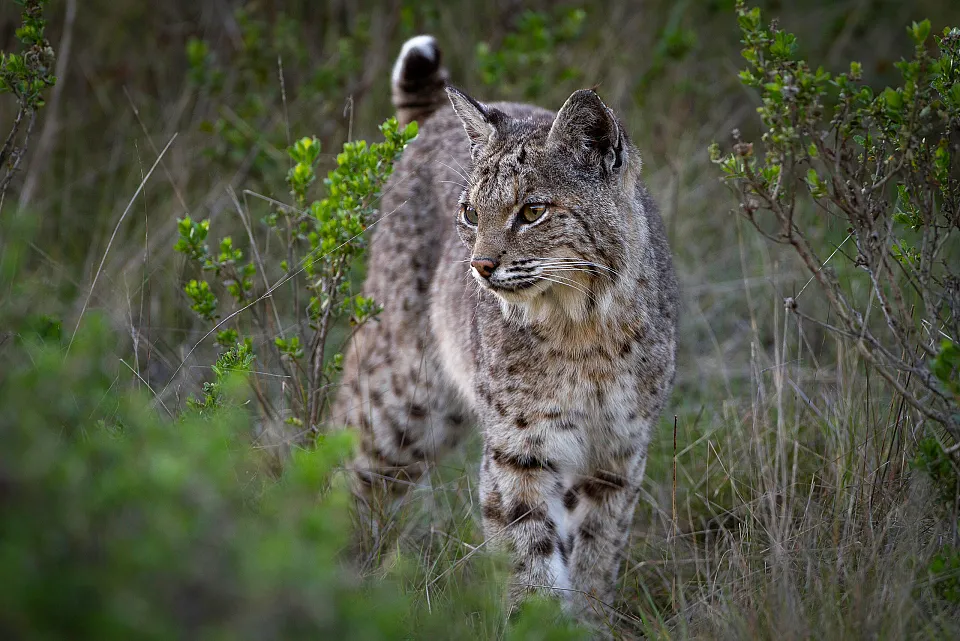
Protecting bobcats from habitat loss & fragmentation
Research
- Focus Species: Lynx rufus (Bobcat)
- Location: San Francisco, California
- Project Status: Ongoing
- Project Start: 2012
California Department of Fish and Wildlife Commission is considering allowing bobcat hunting in the state of California starting in 2025, pending release and review of a statewide Bobcat Management plan, currently being finalized by the agency.
Research data are needed about bobcat populations, status, and health in the Bay Area, as this information is largely unknown.
Objectives
The Bay Area Bobcat Study will look at how human development and habitat fragmentation affect bobcat populations, population status, mortality factors, and health, all of which have not been evaluated in depth for the region.
This study will track bobcat movement through fragmented landscapes and identifying barriers that hinder juvenile dispersal within bobcat metapopulations. Combining fecal surveys and conducting field camera research will reveal where bobcat juveniles are dispersing, and how bobcats are moving on the landscape.
- Movement through the landscape: With these data we will be able to better understand home ranges, dispersal patterns and survivorship.
- Juvenile bobcats must also disperse out of their parental home ranges to establish their own, which often entails having to navigate through a human-altered landscapes with a variety of potential barriers.
- Roadkill data: Identify population choke points or crossing points for local roadways and highways. They determine hotspots where bobcats are hit on roads and identify areas where movement permeability needs to increase using connectivity designs.
- Genetic information and flow between mountain ranges
- Potential human-bobcat interactions: Interactions with pets and livestock.Working with stakeholders to create solutions for managing livestock to prevent loss of livestock (bobcat-proof enclosures for pets and livestock).
Outcomes
Conservation goals:
- Identifying habitat linkages that are critical for bobcat movement and dispersal:
- Work with partners in protecting or improving areas bobcats use to provide safe passageways for them to move throughout the landscape.
- Comparison of movement patterns of bobcats residing in core habitat to bobcats whose home range overlap into urbanized areas and high use roads.
- Assess the genetic status and distribution of bobcats in the region:
- Evaluate genetic flow between mountain ranges by identifying genetic relatedness within the bobcat metapopulation.
- Identify whether genetic isolations and differentiation are occurring due to lack of connectivity.
- Assess the health of bobcat populations through exposure to anticoagulants and cases of mange
- Development of a road mortality database, along with assessment of other mortality factors, to determine the greatest causes of bobcat mortality
- Develop a connectivity plan based on the data to inform conservation planning of a regional linkage design with identification of priority habitats to conserve
- Assess the population density and long term viability of bobcat populations in relation to mortality factors from trapping or hunting for pelts, road kill data, mange and poisoning, and loss of habitat.
Downloads
Gallery
Photos & videos



Fund this project
Camera traps, collar batteries and lab work are what turn field hours into protection.